
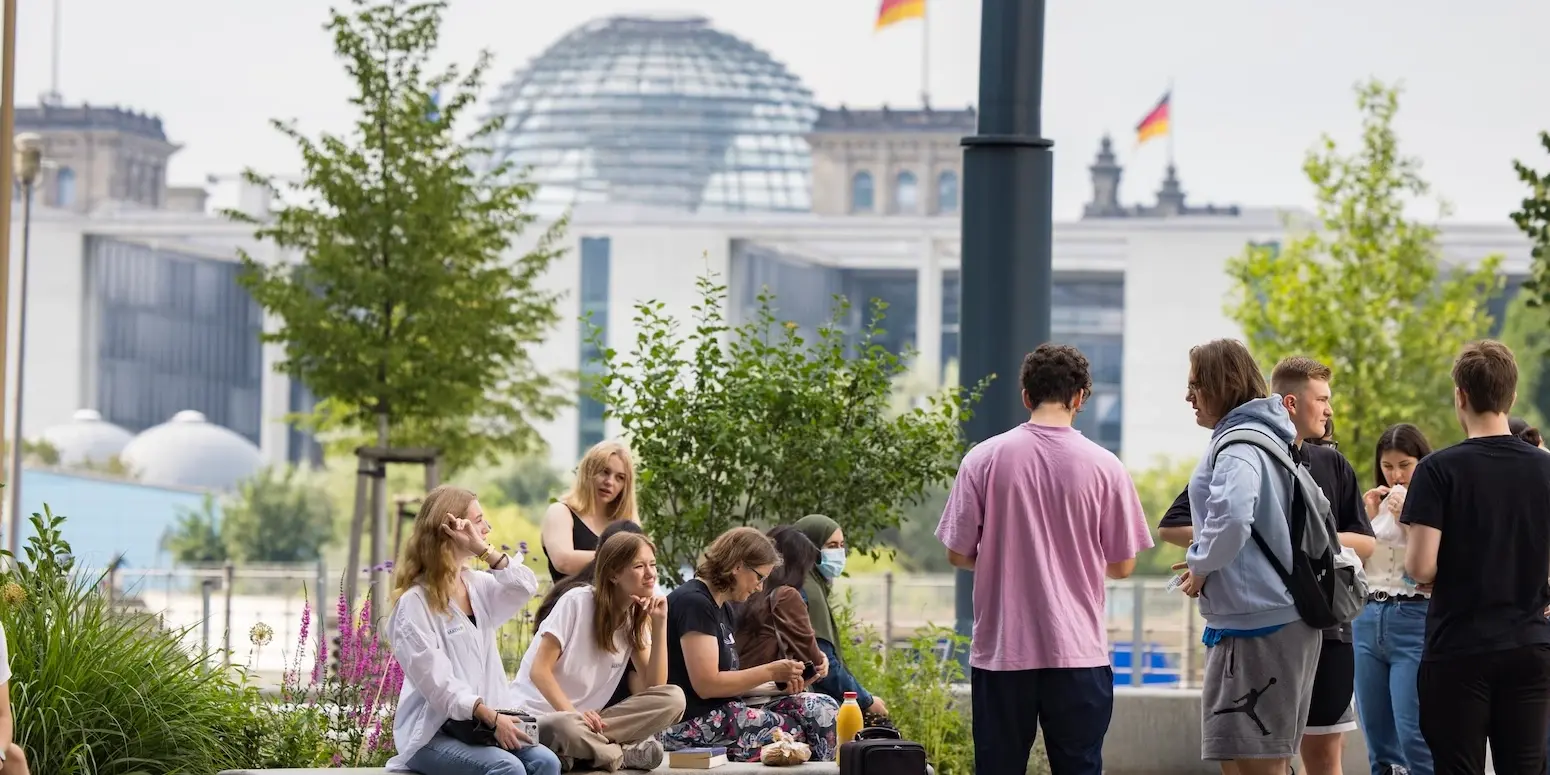
All you need to know about moving to Berlin and starting the BMS program
Here you will find general information on the process after you have been admitted to the BMS and lots of helpful information for your move to Berlin.
The BMS Office will always send you up-to-date information on the enrollment at FU, HU or TU Berlin and a tailored checklist for your arrival in Berlin.
Many administrative and bureaucratic procedures in Berlin involve paper, original signatures and lots of patience and time.
The BMS can help speed up the process where possible but most importantly, you must prepare for your move well in advance and try to get the most important things done within a week after your arrival.
Checklist in short:
- Visa
- Find accommodation
- Get Travel and Health insurance
- Register your address in Berlin (Anmeldung)
- Open a SEPA bank account
- Get your German Tax ID
- Sign your contract (scholarship or employment)
- Enrollment

Annika Preuß-Vermeulen
BMS Coordinator
Please make an appointment for consultations.
Phone.: +49 – 30 – 314-78611
Contact person for:
You should contact the German embassy in your home country as early as possible. The BMS can assist in the process if necessary and will always send new students a “visa letter” directed at the embassy and containing all required points for the visa.
Phase I students will enroll as master students and therefore need a student visa.
Phase II students who are coming to Berlin with a scholarship should also apply for a student visa (for PhD studies).
Student visas are usually issued for 12 months. About 2 months before the visa expires, you will need to apply for a residence permit at the Berlin Immigration Office.
Phase II students who are receiving a project position, i.e. a PhD employment contract, need to apply for a visa for researchers. For this application they will need a confirmation from the Berlin university that they will be employed (incl. dates and salary).
Before the visa expires, you must apply for a residence permit at the Berlin Immigration Office.
The housing situation in Berlin has become very competitive in the last years due to various factors, including the increasing number of immigrants, international students, and the increase in mobility of the population in general. Therefore, it is highly recommended to begin your search for accommodation early in advance.
Rent is the largest monthly expense for students (on average about € 550 per month for a single room). However, the amount of rent depends mainly on the type of accommodation and where it is located. BMS students can attend courses at all three Berlin universities and commute on a daily basis across the city in order to reach them, so finding accommodation in a specific area/neighborhood is a personal choice. Students may choose to apply for a room in a student dormitory, to find a room in a shared apartment, or to rent an apartment independently. Here are some useful links for all types of accommodations.
Student residencies / dormitories
- Studentendorf Schlachtensee: Each year, ten rooms in this student village are reserved for new BMS students on a “first come, first serve“ basis. They are offered to international Phase I students first and to German or Phase II students only when rooms are still available. Each room is fully furnished with a bed, bedlinen, cupboards, shelves, a desk and a chair. Shared bathrooms and kitchens are fully equipped. On-site you can also find a free gym, music rooms, study rooms, a launderette, a supermarket and the student-run bar “Club A18”. The rental period is fixed for one year and starts on 1 September and ends on 31 August. The distance to FU Berlin is about 8 km, to TU Berlin 14 km and 24 km to HU Berlin. In order to apply for one of the rooms, please get in touch with the BMS One-Stop Office.
- Studentendorf Adlershof: This student dormitory is very close to the HU campus in Adlershof, a suburb in southeast Berlin. Each year, five rooms in this student village are reserved for new BMS students on a “first come, first serve“ basis. They are offered to international Phase I students first and to German or Phase II students only when rooms are still available. Each room is fully furnished with a bed, bedlinen, cupboards, shelves, a desk and a chair. Shared bathrooms and kitchens are fully equipped. On-site you can also find a free gym, music rooms, study rooms, a launderette and a supermarket. The rental period is fixed for one year and starts on 1 September and ends on 31 August. In order to apply for one of the rooms, please get in touch with the BMS One-Stop Office.
- studierendenWERK BERLIN: Almost 9,500 accommodation places made up of single rooms and small apartments are available in 33 student residences across Berlin. Studentendorf Adlershof and Studentendorf Schlachtensee also belong to the studierendenWERK.
- Home in Berlin (formerly “House of Nations”): Modern apartments and single rooms for students and trainees in Berlin at reasonable prices at 7 locations spread across the city.
Shared or furnished apartments
Shared apartments (Wohngemeinschaften / WGs) are a popular alternative to student residences. Several people live together in an apartment they have rented privately: everybody has their own bedroom, while the kitchen and bathroom are shared. The advantage is that all roommates share all costs (rent, telephone, internet, and utilities like electricity and water), which means that living in a WG is cheaper than living alone. Please note that rooms in shared apartments are mostly rented unfurnished, so you may need to buy a bed, a desk, bedlinen, shelves and chairs on your own.
The following platforms are typically used to find a room in a shared apartment or to find short term furnished apartments:
- www.wg-gesucht.de/en/wg-zimmer-in-Berlin.8.0.0.0.html
- www.berlin.studenten-wohnung.de (in German)
- www.housinganywhere.com (also single apartments, contact the BMS for a special sign up link)
- www.spotahome.com (furnished, also single apartments/ studios; contact the BMS for a discount code)
- www.vondereurope.com
- www.housingtarget.com/germany/housing-rentals (furnished, also single apartments/ studios)
- www.uniplaces.com
- www.livinghouse.berlin/en
- www.ibz-berlin.de/?lang=en
- www.easy-living4u.de/en (singles)
- www.berlinovo.de/en (families)
- www.wgcompany.de (in German)
Please note that these sites often charge administrative fees for handling the rental agreement between you and the owner/main tenant of the apartment. Caution is advised whenever signing an agreement and transferring money.
Unfurnished, regular apartment
If you decide to rent an apartment independently, you are normally the main tenant and as such you have more rights, but also more responsibilities. Please always read any rental agreement (Mietvertrag) very carefully and do not sign or pay anything until you have understood your contractual obligations and rights. Please note that the majority of apartments rented in Germany are completely unfurnished. This means you will need to buy/collect all of your own furniture – including closets, lamps, refrigerator, kitchen cabinets, etc.
Almost all available apartments (be it from private landlords or public housing agencies) are posted on at least one of the following websites:
– www.immobilienscout24.de (in German)
– www.immowelt.de (in German)
Using the apps of these companies is usually quicker and easier. To find an apartment this way you will usually need the following documents:
- proof of income (salary statements of past three months or e. g. scholarship contract)
- SCHUFA (credit score system in Germany)
- proof that you do not have rental debt from previous landlord (Mietschuldenfreiheitsbestätigung)
- copy of passport (and visa/residence permit)
Before you move in, make a note of any damage or other shortcomings and inform your landlord / housing agency in writing before signing the contract. This will protect you from any possible claims for damages later. You can download a template of a so-called “hand over report” (Übergabeprotokoll) here: https://mieterbund.de/app/uploads/2023/07/Wohnungsuebergabe-Protokoll_neu.pdf (in German)
You should only pay the deposit and first month of rent, once you have seen the apartment and signed the contract. You might encounter scammers that ask you to send them money before viewing the apartment or signing any legal document and then want to send you the apartment key via postal mail. Official housing agencies do not operate like this.
It is also recommended to become a member of a tenant’s association to have legal counsel available in case of conflicts with the landlord / housing agency. One of these is: https://www.berliner-mieterverein.de/sprachen/englisch.htm
You can often find cheap or free furniture on ebay or various other websites: https://www.ebay-kleinanzeigen.de/stadt/berlin/
Some more helpful guides
In Germany, health insurance is a compulsory requirement for students and a necessary condition of enrollment.
The German system has two kinds of health insurance: private and public. BMS students can choose one over another depending on several factors like nationality, costs and general health status. Both types of insurance typically offer online and English services.
- Private health insurance (private Krankenversicherung) is usually the cheaper option, ranging between 40€ and 70€ per month (maximum for the first two years!). However, it may not cover all kinds of treatments (e.g. vaccinations, dental procedures or regular visits without proof of illness are not covered). You will also usually need to pay upfront at doctor’s offices and then ask for a reimbursement from the insurance company, which means you must have some savings available. Typically after two years the insurance fee is raised significantly, for example Continentale raised it from 69€ to 120€ per month for the third year.
- Public health insurance (gesetzliche Krankenversicherung) looks like the more expensive option at first but covers everything. For every doctor’s visit, showing the insurance card will guarantee full coverage. General check-ups like going to the dentist or the OB GYN once a year or vaccinations are covered and do not need a medical reason. Extra payments may be incurred if asking for extra services (e.g. ultrasound if not medically necessary) or in case of major dental work (e.g. bridges or crowns). Phase I students under 30 years old get the student rate which is around 150€ per month. Phase II students and Phase I students over the age of 30 pay 15% of their income.
Phase II students with PhD positions (employment contracts) must choose a public health insurance provider and the fee will be automatically deducted from their salary.
For the university enrollment, students choosing private health insurance will need to obtain a waiver or exemption certificate (Befreiungsbescheinigung) from a German public health insurance company. Please note: it is not allowed to switch from private insurance to a public provider. This can only happen if starting for example an employment contract for the first time, thus switching from a student status into an employee position.
Students from EU/EFTA countries may not need to take out health insurance in Germany as long as they possess a European Health Insurance Card (EHIC). The EHIC is part of a health service agreement between all EU and EFTA countries, which gives citizens of those countries access to medically necessary, state-provided healthcare during a temporary stay in any of the countries. Students should ask the public health insurance provider in their home country to issue an EHIC before moving to Germany. Please find more infos here: https://www.schengenvisainfo.com/europe-travel-insurance/ehic/
Upon arrival, they can obtain an exemption certificate by taking the EHIC to any German public health insurance company. This certificate is also necessary for university enrollment (you can for example email the TK for this waiver at ).
Germany has also signed bilateral social security agreements (Sozialversicherungsabkommen) with some non-EU countries, including Bosnia-Herzegovina, Morocco, Montenegro, North Macedonia, Serbia, Turkey and Tunesia. As for the EHIC, students from these countries should ask the health insurance provider in their home country to issue a certificate of insurance coverage and bring it to a German public insurance provider asking for recognition and exemption from public insurance obligation.
Please refer to the following websites for further information about public and private health insurance in Germany:
Some examples of health insurance providers:
Public:
Private:
English speaking doctors in Berlin
Most doctors speak at least English and some have listed the languages that they speak on their websites. It is worth it to just call the closest one and ask if they speak English. There are no restrictions from your health insurance with regards to choosing a doctor or hospital. However, a few selected doctors (usually in wealthy areas) will declare that they do not accept public health insurance, so look for the words “Alle Kassen” (here “Kasse” means health insurance provider): How to find English-speaking medical professionals in Berlin
TK (public health insurance provider “Techniker Krankenkasse”)
The TK is working together with the FU, HU and TU in Berlin and has offices on campus and designated contact people for all three universities:
- @FU: https://www.landingpage.tk.de/fu-for-students
- @HU: https://www.landingpage.tk.de/forstudents
- @TU: https://www.landingpage.tk.de/tu-students-your-first-steps-in-germany
The TK Study guide offers seminars on health insurance in Germany and other important issues.
Legal stuff and money related things
Every person who moves to Germany, must register their address at a residents’ registration office (Bürgeramt). This is called Anmeldung in German and will be one of your most important documents.
You should also keep this with you when travelling outside of the EU.
Keep this document safe as you will need it on various different occasions.
You can make an appointment at any “Bürgeramt” in Berlin via this website: https://service.berlin.de/dienstleistung/120686
Bring your passport, rental contract and a confirmation form your “landlord” that you moved in.
You need a SEPA bank account for your scholarship payments or salary.
If you do not have one yet and need to open one, you must choose a bank and register an account with them. For students, this should be free.
When opening an account online, you upload all the required documents to the provider’s website. The most common practical issue is not the passport but the Meldebescheinigung (Anmeldung). This is the official proof that you have registered your address in Germany. Some banks also ask for your German tax ID, which is usually sent to your registered address after Anmeldung.
International neo-banks such as Revolut and Wise use simplified application procedures so that you can open your account without a residence permit or proof of residence.
Every person who registers their address in Germany, gets a German tax ID (even if they never pay taxes). The tax ID is sent by post after your residence registration. As this can take several weeks, it is recommended to go the tax office in your district two days after the registration and ask them in person for your tax ID. You can ask the BMS office if you need help finding the relevant tax office.
The tax ID is necessary for the scholarship (Phase I) and for the employment contract (Phase II). You cannot receive any payments by the universities, without your tax ID.
Keep this document safe as you will need it on various different occasions.
Working Contract
The BMS needs all your personal data before signing the scholarship contract:
- Full name and date of birth
- Registered address in Berlin
- SEPA bank account
- German tax ID
The first payment is usually delayed due to the time it takes to collect this information and the time it takes the university accounting to transfer the first payment.
After signing the contract, it usually takes three weeks until receiving the first payment.
The universities are part of the public sector (German: “Öffentlicher Dienst”) in Germany, which means they are state-funded. Your status at the university will be “Wissenschaftlicher Mitarbeiter” (short: WiMi), which translates to scientific employee.
1. Taxes
Income tax will be deducted automatically from your monthly gross salary. If you are employed in Germany with only one employer on a regular basis, you are not required to declare your income. However, for 90% of jobholders it makes sense to hand in an income tax declaration at the end of the year in order to get a refund. Especially, if you did not work the whole year, you will almost certainly get a refund. Please see a tax consultant about details.
2. Statutory Social Security
If you work in Germany, you are automatically subject to social security contributions and health insurance. The contributions to social security and your health insurance fee are shared between employer and employee. Your share of the fee will be automatically deducted from your gross income before you receive your net salary. That means you will be a member of the following five statutory social security organisations:
- The statutory health insurance fund, which pays the costs of visits to the doctor, and for medication and therapy.
- The statutory long-term care insurance fund, which offers basic insurance for the eventuality of your being dependent on long-term care owing to illness. This usually applies to people in old age.
- The statutory pension insurance fund, which pays employees a pension once they have retired. If you are not staying in Germany, you can get this money back. Please ask your HR department about details.
- The statutory accident insurance, which covers the costs of medical treatment and occupational rehabilitation after an accident at work or in the case of an occupational illness.
- The statutory unemployment insurance fund, which provides the unemployed with income for a certain period of time if, as a general rule, they have been insured for at least one year during the last two years and are in search of a new job.
As an employee, you will receive a social security card with a social security number on it. Give this number to your employer. Keep your social security card safe as you will often need the number. If you cannot find it / have never received it, contact your health insurance.
3. VBL
The public sector offers its own additional pension for employees called VBL. It is optional but you have to inform HR right away (before signing the contract) if you do not want the VBL.
Please ask your HR department about further details.
4. Salary and experience levels
Your gross salary is determined by the salary group (Entgeltgruppe) and your experience step (Erfahrungsstufe). There are 15 salary groups in the TVL (Tarifvertrag der Länder) with 15 being the highest and 1 being the lowest. PhD students and postdocs are employed in salary group TVL 13. There are 5 to 6 experience steps in each salary group.
If a new employee has no previous experience, they automatically start in experience step 1. After one year in step 1, they move on to step 2. After two years in step 2, they move on to step 3 and so on. To start in a higher experience step than 1, you must prove to the HR department that you already have relevant working experience in your field. For this purpose, you will need to list your previous work in great detail with start and end dates and information on how many weekly hours you worked on each project. You can submit employment contracts or reference letters as proof.
After you are hired at the university and have received an employee email account, you can use this account to access your personal “university portal” and download your salary statements there every month.
5. Vacation
Full-time employees have 30 working days of vacation in a year. Part-time employees, who work five days a week, also have 30 vacation days. Saturdays, Sundays and public holidays do not count as working days. You will need to ask your supervisor for permission and sign a form together each time, you want to take one or more vacation days.
If you have some vacation days left, you can add the days to the following year. Note that your “left over” vacation days are only valid until the 30th of September of the next year.
Should you fall ill while on vacation, you should inform your department/supervisor immediately and send a doctor’s note to your HR department. These days will then count as sick leave and not as vacation days.
6. Ilness / Sick leave
If you are ill, you must inform your department/supervisor before 10.00 am and if possible inform them how long you will be absent. Your department should tell you which person within the HR department to call or contact via e-mail for the notification of illness (Krankmeldung).
If you are ill for more than three days, you will need a doctor’s note for the next day(s).
Examples:
You call in sick on Wednesday and are sick on Thursday and Friday as well, but come back to work on Monday = You do not need a doctor’s note as it is assumed that you were already healthy again on Saturday.
You call in sick on Friday and are still sick on Monday. = It is assumed that you were sick all weekend long, so Monday is the fourth day of your sick leave and you must provide a doctor’s note. The doctor will give you three copies of your note, one for yourself, one for the HR department and one for your health insurance provider. You will need to send the doctor’s note to your HR department and not to your supervisor. However, you must of course inform your supervisor how long you will be absent. You will also need to send your note to your health insurance provider. Some accept these online.
If you have an accident at work or on the way to work, you will need to file an accident report and send it to your HR department.
When you are able to work again, you will need to inform your supervisor and HR department immediately (Gesundmeldung).
If you are sick for more than six weeks, the university will stop paying your salary and you will need to apply for Krankengeld “illness payment” at your health insurance provider.
7. Travelling for work (Conferences etc.)
If you want to to visit a conference or take any other work-related trip, you must ask your supervisor for permission. Even if your expenses are covered, you must fill in the “Application for conducting travel”, ask your supervisor for their signature and submit it to the relevant department.
If you need some expenses to be reimbursed, you will need to clarify this on the application form and with your supervisor beforehand. There are several laws and regulations in place regarding travel reimburstements.
You may find more information here: https://www.math-berlin.de/index.php/students/travel-regulations/for-conferences And on the official website of your university’s travel department.
8. Further Infos / Advice
If you have any problems or questions about your employment contract, the Personalabteilung of the university/institution at which you are employed should help you.
In particular, the Personalrat counsels employees and represents their interests in the university administration:
Academic Matters
Phase I students need to enroll by a certain deadline which is usually 1-2 months before the start of the semester. The BMS Office will inform all new students about the relevant enrollment process for the Masters in Mathematiis at FU, HU and TU.
Phase II students will need to declare their intent to pursue a PhD at the university faculty first. After they have been accepted there, they can enroll at their university as a PhD student. They pay the same semester fees as Bachelor and Master students and get the same student benefits.
The regular BMS program starts in the winter semester which begins in October. All students are recommended to arrive in Berlin one month earlier so at the beginning of September, in order to get settled, take care of all administrative procedures (incl. the enrollment) and attend the BMS Language Course. Phase II students can be more flexible with their start of the BMS program as this mainly depends on their funding situation. There is also no enrollment deadline at FU, HU or TU for Phase II students.
BMS Buddy program
In the BMS Buddy program, new students are helped by a BMS student, who usually comes from a similar cultural background. Your buddy should help you in your first weeks after your arrival, e.g. by picking you up from the airport, accompanying you to your Anmeldung appointment or just sharing their experiences in the BMS program (courses, exams, professors etc.)
BMS Language Course
The BMS organizes two German language courses for the last two weeks of September every year. One course is at the beginner’s level (A0) and one is at a slightly higher level (usually A2). These two courses are offered to the new students first and if there are still places available, these will be offered to all current BMS students.
The BMS does not offer a German language course for B or C levels, as there is rarely a group of new students with such advanced German language skills.
BMS Orientation
At the beginning of October, the BMS welcomes all new students with the BMS Orientation Week. Attendance of the orientation week is mandatory. This week consists of:
- the BMS Orientation Day with all info about the program
- a short introduction to the BMS Core Courses
- a Master’s Study Regulations Meeting for all new Phase I students
- a Good Scientific Practice Seminar for all new Phase II students
- Campus Tours at FU, HU and TU organized by the BMS Student Representatives
- an Intercultural Training
- a Berlin Walking Tour
The BMS sends all new students an invitation with all relevant details at the beginning of September.
All BMS students will receive an email on how to register for courses with all the current deadlines at the end of September. By mid-October all students should be enrolled and have registered for their courses. The first lectures start in the second or third week of October.